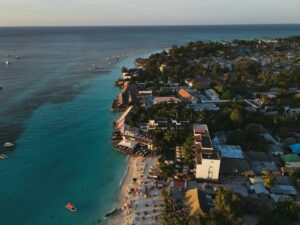
Twin-centre holidays, and multi-centre holidays with three or more stops, are how most of our clients now travel long-haul. Rather than one hotel for a fortnight, you spend a few days somewhere with plenty to see, then fly on to a beach and do very little. Done well, the long flight is shared between two places, the second stop is a short hop away, and the trip feels like two holidays rather than one tiring one.
This guide covers the combinations we book most, from Sri Lanka and the Maldives to New York and Barbados, with the best months, how the flights connect and how to split your nights. For dates, ideas and every package we offer, see the full range on our multi-centre hub.
The quick answer
- Sri Lanka and the Maldives is the classic pairing for culture then beach, best from about December to April.
- Dubai and the Maldives is the easiest: two flights on one airline, best in the cooler months from about November to April.
- Dubai and Mauritius suits autumn and spring, when Dubai is cooler and Mauritius is at its most comfortable.
- New York and Barbados pairs a city break with Caribbean sun, and you can fly home direct from Barbados.
- Singapore and Bali works best in Bali’s dry season, roughly April to October.
- Split your nights about three or four in the city and a week or more on the beach.
The best combinations at a glance
Flying times are typical scheduled times from London, rounded, for each leg in the outbound direction. They exclude time on the ground between flights, and they vary a little by season and aircraft.
| Pairing | Best months | Flying time from the UK | Suggested split | Best for |
|---|---|---|---|---|
| Sri Lanka and the Maldives | December to April | About 12 hours (11 to Colombo, 1.5 on to Malé) | 8 to 10 nights, then 5 to 7 | Culture, wildlife and a reward at the end |
| Dubai and the Maldives | November to April | About 11 hours (7 to Dubai, 4 on to Malé) | 3 nights, then 7 or more | Honeymoons and the simplest logistics |
| Dubai and Mauritius | October to early December, April and May | About 13.5 hours (7 to Dubai, 6.5 on to Mauritius) | 3 nights, then 7 to 10 | Families and couples who want variety on the island |
| New York and Barbados | Late November to December, April and May | About 13 hours (8 to New York, 5 on to Barbados) | 3 or 4 nights, then 7 to 10 | Christmas shopping, then Caribbean sun |
| Singapore and Bali | April to October | About 16 hours (13 to Singapore, 3 on to Bali) | 3 nights, then 8 to 10 | Food, culture and villa life |
| Tanzania safari and Zanzibar | June to October, January and February | About 11 to 13 hours with one change, then about an hour on to Zanzibar | 5 to 7 nights on safari, then 5 to 7 | The Serengeti and the Big Five, then a beach |
| Kenya safari and coast | July to October, January and February | About 8.5 to 9 hours non-stop to Nairobi, then a short flight to the Mara or the coast | 4 to 5 nights on safari, then 5 to 7 | The Masai Mara, then the Indian Ocean |
Multi-centre, twin-centre or two-centre holidays: what’s the difference?
The terms overlap. A twin-centre holiday has two stops, usually a city or touring region and then a beach. A multi-centre holiday is the broader name for any trip with two or more bases, which might be three stops, such as Dubai, Sri Lanka and the Maldives, or several islands in one country. You will also see them called two-centre holidays or multi-destination holidays; they all mean one trip with more than one base, booked together.
Whichever you call it, the same things make it work: a first stop that suits the jet lag, a short onward flight, and enough nights in each place that you are not living out of a suitcase. Two centres is the sweet spot for a ten to fourteen night holiday. Three works well from about two weeks, as long as one of them is a proper rest.
Sri Lanka and the Maldives
- Best: December to April
- Flying: about 11 hours, then 1.5
- Split: 8 to 10 nights, then 5 to 7
Why it works. The two complement each other perfectly. Sri Lanka is a touring holiday: the ancient cities and rock fortress of the Cultural Triangle, tea country in the hills, leopards in the national parks and the old Dutch fort at Galle. It is busy and rewarding, and the Maldives is the perfect antidote, a week of water, reef and no plans at all.
Best months. Sri Lanka’s Department of Meteorology divides the year into the northeast monsoon (December to February), the first inter-monsoon (March and April), the southwest monsoon (May to September) and the second inter-monsoon (October and November). The southwest monsoon brings the rain to the west and south coasts and the hills, so the classic route is at its best from about December to April. The Maldives Meteorological Service puts the Maldives’ dry season at January to March, with December and April as transition months, so the two line up neatly. In the summer months, Sri Lanka’s east coast comes into its own, though it is the wetter season in the Maldives.
How the flights connect. SriLankan Airlines flies non-stop from Heathrow to Colombo in about 10 hours 45 minutes. From Colombo, the hop to Malé is about an hour and a half. Coming home, British Airways flies non-stop between Malé and Heathrow on a seasonal schedule, so you need not go back through Colombo. In the Maldives, the last leg to your island is by speedboat, seaplane or a domestic flight. Seaplanes fly only in daylight, so we plan your arrival time around the transfer.
How many nights. Eight to ten nights in Sri Lanka covers the Cultural Triangle, the hill country and a little of the south coast without rushing. Then five to seven nights in the Maldives. If you have less time, cut the touring, not the beach.
See Sri Lanka and Maldives holidays →
Dubai and the Maldives
- Best: November to April
- Flying: about 7 hours, then 4
- Split: 3 nights, then 7 or more
Why it works. This is the simplest long-haul twin-centre there is. Dubai sits roughly halfway, so a few nights there break the journey and give you a complete contrast: the view from the Burj Khalifa, the old souks along Dubai Creek, a desert evening, and some of the best hotel dining in the world. Then on to the Maldives for overwater villas and house reefs.
Best months. Dubai’s summer is extremely hot, so we pair it with the Maldives in the cooler months. The UAE’s National Center of Meteorology gives average winter daytime highs of about 24 to 27°C, which is perfect for being out and about. That overlaps well with the Maldives’ dry season from January to March, and the transition months either side.
How the flights connect. Emirates flies from Heathrow, Gatwick and several regional UK airports to Dubai, in about 7 hours from London, and on to Malé in about 4 hours. You can stop in Dubai on the way out or on the way home; the way home is often the better choice, as it turns the return into two shorter flights.
How many nights. Three nights in Dubai is right for most people, with seven or more in the Maldives. Two nights is enough if Dubai is purely a stopover.
See Dubai and Maldives holidays →
Dubai and Mauritius
- Best: October to early December, April and May
- Flying: about 7 hours, then 6.5
- Split: 3 nights, then 7 to 10
Why it works. Mauritius is a bigger, more varied island than most beach destinations, with mountains, gorges and a strong food culture alongside the lagoons. It suits families and anyone who wants more to do than lie on a sunlounger. Dubai on the way out turns a long journey into two manageable flights.
Best months. The Mauritius Meteorological Services describe a warm, humid summer from November to April, which brings about two-thirds of the year’s rain, and a cooler, drier winter from June to September. The cyclone season covers the summer months. Dubai is too hot for sightseeing in high summer, so the best overlap is in autumn, from about October to early December, and again in April and May. Winter in Mauritius is pleasant too, with mean temperatures around 20°C, but Dubai is at its hottest then.
How the flights connect. Emirates links the two, about 7 hours from London to Dubai and about 6 hours 35 minutes from Dubai to Mauritius. Dubai and Mauritius share the same time zone, so the second leg costs you no sleep.
How many nights. Three nights in Dubai, then seven to ten in Mauritius. With ten or more, consider two hotels on different coasts of the island.
See Dubai and Mauritius holidays →
New York and Barbados
- Best: late November to December, April and May
- Flying: about 8 hours, then 5
- Split: 3 or 4 nights, then 7 to 10
Why it works. Few pairings offer such a contrast. A few days of galleries, Broadway and restaurants in Manhattan, then a week on Barbados’s calm west coast. It is one of our favourite Christmas trips: the city at its most festive, then winter sun.
Best months. New York is at its most comfortable in late spring and autumn; the National Weather Service’s Central Park normals give average highs of about 22°C in May and 18°C in October. December brings the cold, but also the lights and window displays. The Met Office gives Barbados’s rainy season as June to October, and the Atlantic hurricane season runs from 1 June to 30 November. So the best combinations are late November to December, for Christmas in the city and the start of the Caribbean winter season, or April and May.
How the flights connect. British Airways flies from Heathrow to New York JFK in about 8 hours. From JFK, JetBlue flies non-stop to Barbados in about 5 hours. You don’t need to go back through New York: British Airways flies direct from Barbados to London, year-round to Heathrow and, from the 2026/27 winter season, to Gatwick too.
How many nights. Three or four nights in New York, then seven to ten in Barbados.
See New York and Barbados holidays →
Singapore and Bali
- Best: April to October
- Flying: about 13 hours, then 3
- Split: 3 nights, then 8 to 10
Why it works. Singapore is the ideal first stop after a long flight: safe, spotless, easy to get around and with some of the best food in Asia, from hawker centres to fine dining. Bali then offers two holidays in one, the rice terraces and temples around Ubud and a beach villa on the coast.
Best months. Singapore is hot and humid all year, and the Meteorological Service Singapore notes rain in every month. Bali has a much clearer dry season, roughly April to October, so plan around Bali and slot Singapore in at the start. For the month-by-month detail, see our guide to the best time to visit Singapore.
How the flights connect. Singapore Airlines flies non-stop from London to Singapore in about 13 hours 10 to 25 minutes, depending on the service. Singapore to Bali is a little under 3 hours, with Singapore Airlines and Garuda Indonesia among the airlines flying direct.
How many nights. Three nights in Singapore, then eight to ten in Bali, perhaps four in Ubud and five or six on the coast.
To go beyond Bali, to Java, Lombok, Komodo or Sumatra, see our Indonesia holiday guide.
See Singapore and Bali holidays →
More multi-centre combinations
These are the other combinations we plan regularly. Each links to the package page with suggested itineraries.
- Dubai, Sri Lanka and the Maldives. A three-centre trip for two weeks or more: a city stopover, a tour, then the beach.
- Abu Dhabi and the Maldives. A quieter alternative to Dubai, with the Sheikh Zayed Grand Mosque and the Louvre Abu Dhabi.
- Kenya safari and coast. Game drives in the Masai Mara, then the Indian Ocean beaches.
- Tanzania safari and Zanzibar. The Serengeti, then the beaches of Zanzibar and the old town of Stone Town.
- Cape Town and Kruger. The city, the winelands and the coast, followed by safari.
- Kruger and Mauritius. Safari then island, one of the great bush-and-beach combinations.
- Seychelles island hopping. Mahé, Praslin and La Digue, each with a different character.
Thailand multi-centre holidays
Thailand is made for a multi-centre trip: a few nights in Bangkok for the temples, markets and food, the old city and hill country around Chiang Mai in the north, then an island to finish. Domestic flights are short, so three centres fit comfortably into two weeks. Pick the coast by month: the Andaman side, around Phuket and Krabi, is at its best in the dry months from about November to April, while the Gulf islands such as Koh Samui are a better bet in the summer. See our guide to Thailand multi-centre holidays for routes.
Multi-centre holidays in the USA
The classic USA multi-centre starts in New York, then heads south for the sun: Florida, for the theme parks of Orlando or the beaches around Miami, or the Caribbean. The Caribbean option is the easiest to fly home from, as British Airways flies direct from Barbados to London. See our New York and Barbados holidays.
For more ideas on pairing a safari with the sea, see our guide to safari and beach holidays.
Closer to home: city and beach twin-centres in Europe
Twin-centres work just as well on a shorter flight, with a train or a drive between the two stops rather than a second flight. These are the European pairings we suggest most often:
- Rome and Sorrento. A fast train from Rome to Naples, then on to Sorrento and the Amalfi Coast.
- Venice and Lake Garda. A train via Verona takes you from the canals to the lakeside.
- Dubrovnik and Montenegro. A drive down the coast to the Bay of Kotor and Montenegro’s beaches.
- Split and the Makarska Riviera. A short drive south from Split to the pebble beaches below the mountains.
- Barcelona and the Costa Brava. A city break, then the coves and resorts north of the city. See our Spain holidays.
- Marrakech and Agadir. The souks and riads of Marrakech, then the Atlantic coast by road. See our Morocco holidays.
How to plan a multi-centre holiday
- Plan around the beach. Beach weather is usually the deciding factor, so fix the beach dates first and fit the city or touring part around them.
- Do the busy part first. You are freshest at the start, and finishing on the beach means you come home rested. The exception is a Gulf stopover, which often works best on the way home.
- Keep the connection short. The best pairings are a single flight of a few hours apart, ideally with one airline or partners, so your bags go through.
- Avoid doubling back. Where possible, fly home from the second stop, as with Barbados or the Maldives, rather than returning through the first.
- Give each place enough time. Three nights is the minimum for a city to feel like more than a stopover. On the beach, a week is ideal.
- Book it as one package. A Travel Designer can combine the flights, hotels and transfers into one ATOL-protected holiday, so if a flight is delayed, the onward arrangements are looked after.
Planning the beach part? Our guides to the best time to visit the Maldives, the best Maldives islands and resorts and the best time to go to Mauritius go into more detail.
Frequently asked questions
What is the difference between a multi-centre and a twin-centre holiday?
A twin-centre holiday combines two places in one trip, often a city and a beach. A multi-centre holiday is the wider term for any trip with two or more stops, such as Dubai, Sri Lanka and the Maldives. The planning principles are the same.
What are the best twin-centre holidays from the UK?
Our most requested are Sri Lanka and the Maldives, Dubai and the Maldives, Dubai and Mauritius, New York and Barbados, and Singapore and Bali. Each pairs a city or culture-rich first stop with a beach, linked by a short onward flight.
How many nights should I spend in each place?
Three or four nights is usually right for a city such as Dubai, New York or Singapore, with a week or more on the beach. A touring destination like Sri Lanka needs longer, typically eight to ten nights before the beach.
Should I do the city or the beach first?
We usually suggest the city or touring part first, while you are fresh, and finish on the beach. With Dubai, a stop on the way home also works well, as it breaks the return journey.
When is the best time for Sri Lanka and the Maldives?
Roughly December to April. The Maldives Meteorological Service puts the dry season at January to March, with December and April as transition months, and that is also the best time for Sri Lanka’s west and south coasts and the hill country.
Can you book a multi-centre holiday as one package?
Yes. A Travel Designer can put the flights, hotels and transfers together as one ATOL-protected package, so the connections are planned and protected as a whole.
Plan your multi-centre holiday
Our Travel Designers match the right two or three places to the month you want to travel, then plan the flights, transfers and hotels so every connection works, all as one ATOL-protected package.
Keep planning
- All multi-centre holidays
- Maldives holidays
- Sri Lanka holidays
- Mauritius holidays
- Barbados holidays
- Maldives offers
Updated November 2026. Flying times are typical scheduled times published by the airlines and can change with the season. Weather notes are based on the national meteorological services of each destination. Your Travel Designer will confirm current routes and schedules for your dates.