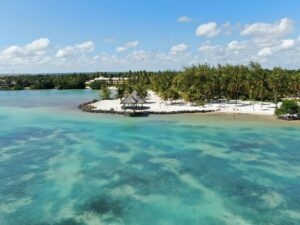
Mauritius and the Seychelles are the two great island holidays of the western Indian Ocean, and from the UK they look similar: long flights, warm seas, white sand and smart beach hotels. On the ground they are very different. Mauritius is one large volcanic island ringed by a coral lagoon, with big resorts, golf, a busy multicultural food scene and a direct flight from London. The Seychelles is a scatter of granite islands near the equator, with smaller hotels, rainforest, giant tortoises and some of the most photographed beaches in the world, and it is reached with a change of plane.
This guide compares the two side by side for UK couples and families: flights, weather by month, beaches, cost, where to stay, food, diving and things to do, and who each one suits. It also covers the option many of our clients choose, which is to do both. For timing in more detail, see our Mauritius weather by month and best time to visit the Seychelles guides.
The quick answer
- Choose Mauritius for families, all-inclusive, golf, value, food and a direct flight.
- Choose the Seychelles for granite beaches, nature, small hotels and island hopping.
- Cost: Mauritius is usually cheaper for the same standard of hotel; the Seychelles costs more and the flight has a stop.
- Best months for both: April to May and October to November.
- Can’t decide? Do both. The flight between them takes about two and a half hours, and twelve nights split six and six works well.
Mauritius and Seychelles trips we plan
- Mauritius and Seychelles twin-centre: 12 nights, with six at Belle Mare on the east coast of Mauritius and six at Port Launay on Mahé, with flights, the flight between the islands and private transfers, from £3,195pp for June 2027 departures.
- Seychelles island hopping: 12 nights, four each on Mahé, La Digue and Praslin, with flights, ferries and the short flight back to Mahé, from £3,379pp on selected dates.
- Dubai and Mauritius: 10 nights, with three in Dubai and seven on half board at Blue Bay, with flights, from £2,623pp in June and from £3,423pp in March.
- Dubai and the Seychelles: 10 nights, with three in Dubai and seven on Beau Vallon beach, Mahé, with flights, from £3,993pp in early December and from £4,543pp in February.
- Kenya safari and Mauritius: 12 nights, with three in the Masai Mara, a night in Nairobi either side and seven on the north coast of Mauritius, with flights, from £4,325pp in October and November.
- Cape Town and Mauritius: 12 nights, with five in Cape Town and seven all-inclusive in Mauritius, with flights, from £2,939pp on selected dates.
- Mauritius or Seychelles tailor-made: we set the islands, nights, hotels and season around you. Make an enquiry.
Mauritius vs Seychelles at a glance
The short version, side by side. Flight times are typical from London and schedules change, so your Travel Designer confirms the current options for your dates.
| Mauritius | Seychelles | |
|---|---|---|
| Flight from London | About 12 hours direct | About 13 to 15 hours with one change |
| Direct flights | Yes, from Heathrow with Air Mauritius, and from Gatwick | None from the UK at present; change in Dubai, Doha or Abu Dhabi |
| Time difference | GMT+4: four hours ahead in the UK winter, three in summer | GMT+4: the same as Mauritius |
| The islands | One large volcanic island with mountains, sugar cane and a reef lagoon | Granite islands (Mahé, Praslin, La Digue) plus far-flung coral atolls |
| Beaches | Long, soft beaches inside a reef lagoon; calm, shallow water | Smaller coves framed by granite boulders; clearer, deeper water |
| Cost level | Mid to high; plenty of value at four stars | High; fewer good-value beach hotels |
| Food | Indian, Creole, French and Chinese; great street food | Creole cooking built on fish, curries and fruit; fewer places to eat outside hotels |
| Activities | Golf, kitesurfing, catamarans, hiking, waterfalls, whale and dolphin trips | Nature walks, giant tortoises, cycling on La Digue, boat trips to small islands |
| Diving and snorkelling | Good, best on the north and west coasts; snorkel in the lagoon | Very good, with granite reefs, marine parks and turtles |
| Families | Excellent: kids’ clubs, family rooms, all-inclusive, calm lagoons | Better with older children; fewer big family resorts |
| Honeymoons | Strong: spas, lagoon villas, good value | Strong: dramatic scenery, smaller hotels, private-island resorts |
| Island hopping | Not really: one island, plus Rodrigues by plane | Yes: easy ferries between Mahé, Praslin and La Digue |
| Best months | May to November (driest); cyclone risk January to March | April to May and October to November (calmest seas) |
| Value | Better, especially June to September | Lower, but island hopping gives a lot of variety |

Two very different islands
Mauritius: one island, many coasts
Mauritius is a single volcanic island, small enough to drive from north to south in under two hours, with a coral reef around most of its coast. Inside the reef the water is calm, shallow and turquoise, which is why the island is so good for families and for swimming. Inland are green mountains, sugar cane fields, waterfalls, tea estates and the Black River Gorges National Park. The people are a mix of Indian, African, French and Chinese descent, and you see it everywhere: in the Hindu temples, the Creole music, the markets of Port Louis and above all in the food.
Each coast feels different. The east (Belle Mare, Trou d’Eau Douce) has long beaches and the island’s best lagoon but is breezier in winter. The north (Grand Baie, Pereybère) is livelier, with restaurants and boat trips. The west (Flic en Flac, Tamarin) is the sunniest and calmest coast in winter, with sunsets over the sea, and Le Morne in the south-west has the mountain, the kitesurfing lagoon and some of the smartest resorts. The south is wilder and quieter. Our Mauritius coast-by-coast guide explains which suits whom.
The Seychelles: granite islands near the equator
The Seychelles is made up of more than a hundred islands spread over a huge area of ocean, but almost every visitor stays on the inner granite islands in the north. Mahé is the largest, with the international airport, the small capital Victoria, forested mountains and dozens of beaches. Praslin, about an hour away by fast ferry, has the Vallée de Mai, a UNESCO-listed palm forest where the coco de mer grows, and some of the best beaches in the country. La Digue, a short hop from Praslin, is a small island where most people get around by bicycle, and it is home to Anse Source d’Argent, the beach of smooth pink-grey granite boulders you have probably seen in photographs.
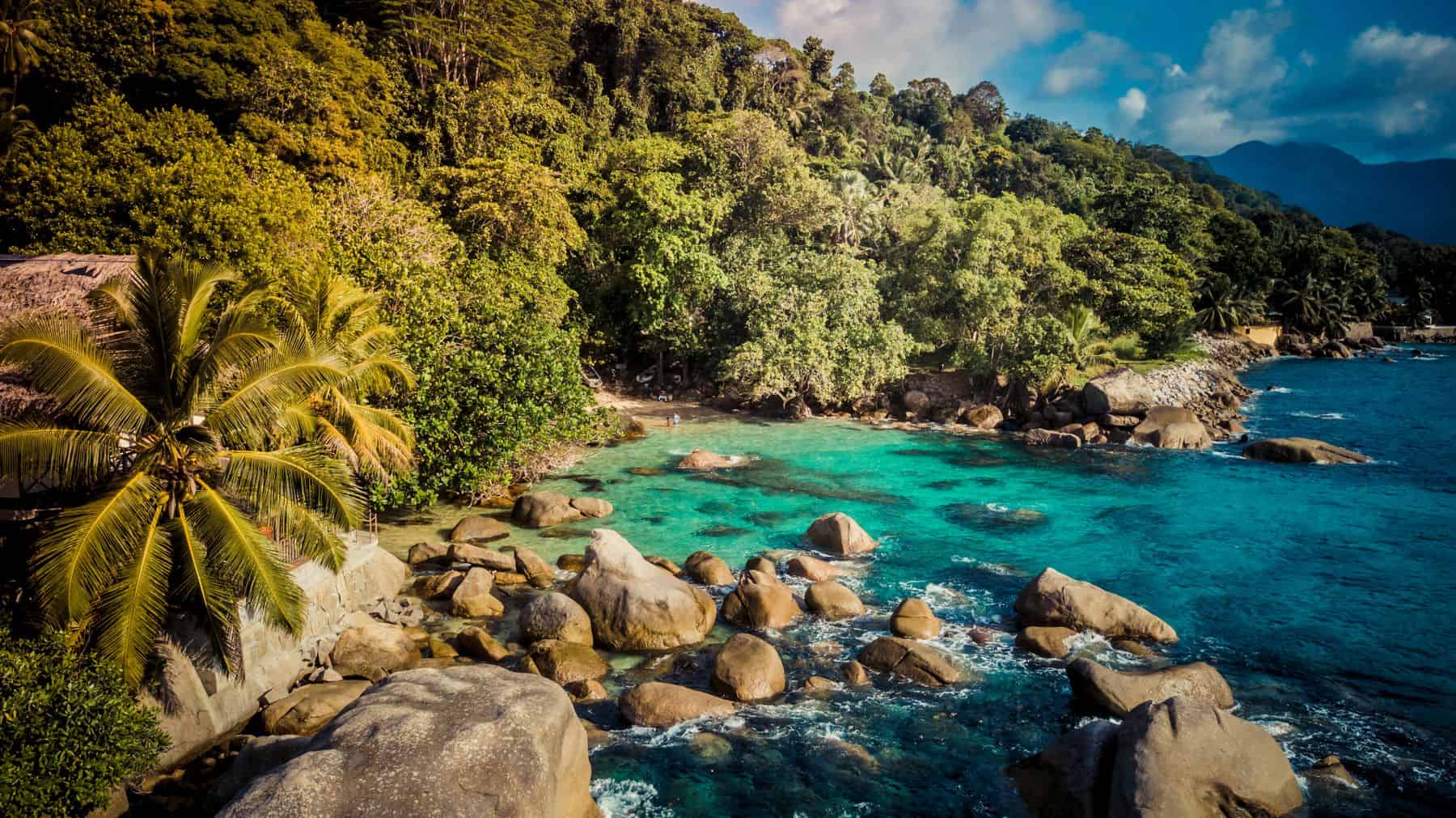
The granite gives the Seychelles its look: rounded boulders on the beaches, steep green hills behind them and clear water over rock and coral. It is also a country that takes nature seriously, with marine parks, nature reserves and island sanctuaries, and giant tortoises that you will meet on several islands. Our Seychelles holiday guide covers each island in turn.
Beaches: lagoon or granite coves?
This is often what decides it. Mauritius has long, soft beaches running for a kilometre or more inside the reef, with gentle, shallow water that stays calm for swimming and paddling. They are classic resort beaches, usually with a hotel behind them, sun loungers and a water-sports hut. Belle Mare on the east coast, Trou aux Biches in the north-west and the lagoon at Le Morne are among the best.
Seychelles beaches tend to be smaller and wilder: coves of white sand between granite boulders, with forest running down to the shore and clear, deeper water. Many have no hotel at all. Anse Lazio on Praslin and Anse Source d’Argent on La Digue are the famous ones, and Mahé has quiet bays all along its west coast. The trade-off is that some beaches have strong currents or become choppy when the wind blows onshore, and on some the water is shallow at low tide, so it pays to stay on the coast that is sheltered in the month you travel.
Weather in Mauritius and the Seychelles by month
The two have quite different climates, even though both are warm all year. Mauritius lies in the southern tropics, so it has real seasons. Summer, from about November to April, is hot and humid, with most of the year’s rain, and it is also the cyclone season, with the highest risk from January to March. In most years the island is not hit directly, but a passing storm can mean a few days of strong wind, heavy rain and rough seas. Winter, from June to September, is cooler and drier, with days in the mid-20s. The south-east trade winds blow at their strongest then, so the east and south coasts are breezy while the west and north stay sheltered and sunny.
The Seychelles sits just south of the equator, so the temperature barely changes through the year, and the main granite islands lie outside the usual path of Indian Ocean cyclones. Instead, the year is shaped by two trade winds. From about December to March the north-west monsoon brings the hottest, most humid weather and the heaviest showers. From about June to September the south-east trades blow, which is the driest time but also the breeziest, with choppier seas on south-east-facing beaches. In between, in April and May and again in October and November, the winds drop and the sea is at its calmest and clearest.
Good mostly dry or calm Mixed good, but breezy or showery Wet the wet or cyclone season
| Month | Mauritius (Grand Baie and Belle Mare) | Seychelles (Mahé) | Which is better? |
|---|---|---|---|
| January | Wet 29°C, 220 mm north, 250 mm east | Wet 27°C, 260 mm | Hot and wet in both. Mauritius is in its cyclone season; the Seychelles has its wettest spell. South-east-facing Seychelles beaches are the calmer choice. |
| February | Wet 29°C, 130 mm north, 190 mm east | Mixed 28°C, 180 mm | The Seychelles, usually. Mauritius is still in peak cyclone season. |
| March | Mixed 29°C, 120 mm north, 180 mm east | Good 28°C, 115 mm | The Seychelles: the winds drop and the sea calms. Mauritius dries out late in the month. |
| April | Good 28°C, 75 mm north, 155 mm east | Good 28°C, 145 mm | Both. Calm seas in the Seychelles, a drier and fresher Mauritius. A good month to combine them. |
| May | Good 27°C, 40 mm north, 80 mm east | Good 28°C, 190 mm | Both. Mauritius is dry and warm on the north and west coasts; the Seychelles is calm, with some showers. |
| June | Good 25°C, 20 mm north, 65 mm east | Mixed 27°C, 100 mm | Mauritius on the west or north coast, with good value. The Seychelles is dry but breezy. |
| July | Good 25°C, 25 mm north, 70 mm east | Mixed 26°C, 65 mm | Either, picking the sheltered coast. Mauritius is cooler (about 25°C); the Seychelles is warmer but windy on south-east coasts. |
| August | Good 25°C, 25 mm north, 60 mm east | Mixed 26°C, 60 mm | Either: both are dry. Mauritius for whales and value, the Seychelles for warmth. |
| September | Good 26°C, 20 mm north, 55 mm east | Good 26°C, 135 mm | Mauritius at its driest and warming up; the Seychelles as the winds ease. |
| October | Good 27°C, 30 mm north, 65 mm east | Good 27°C, 135 mm | Both: one of the best months to combine them. |
| November | Good 28°C, 40 mm north, 90 mm east | Good 27°C, 200 mm | Both: one of the best months to combine them. Showers start to return to the Seychelles late in the month. |
| December | Good 29°C, 95 mm north, 140 mm east | Wet 27°C, 315 mm | Mauritius, which is hot and still fairly dry before the cyclone season peaks. December is the Seychelles’ wettest month. |
Average daily high and average monthly rainfall, from ERA5 weather data for 2014 to 2023. Grand Baie is on the north coast of Mauritius and Belle Mare on the east; the west coast around Flic en Flac is drier still in winter, with as little as 15 mm in June and July. Individual years vary.
Two things stand out. Mauritius is clearly the drier choice from May to November, and the Seychelles is the better bet from February to April, when Mauritius is still hot, humid and at risk of storms. December and January are the hardest months for both: Mauritius is hot with the cyclone season starting, and the Seychelles has its wettest weather, though showers there are usually heavy and short. For every month and every coast in detail, see our best time to visit Mauritius and Seychelles weather by month guides.
The best time to visit both
If you want to combine the two, or simply keep both on the table, aim for April to May or October to November. In those months the Seychelles has calm seas for ferries, swimming and snorkelling, and Mauritius is dry and warm on every coast without the summer humidity. October half-term is a good fit for families, and early May works well for honeymoons after a spring wedding.
| If you travel in | Our pick | Why |
|---|---|---|
| Christmas and New Year | Mauritius, west or north coast | Hot and mostly sunny before the peak cyclone months; the Seychelles is at its wettest |
| February half-term | The Seychelles, south-east coast | Warm and showery, but outside the cyclone belt |
| Easter | Either, or both | The end of the wet season in Mauritius and the start of the calm season in the Seychelles |
| May half-term | Either, or both | Dry in Mauritius, calm seas in the Seychelles |
| Summer holidays | Mauritius for value, the Seychelles for warmth | Both are dry; pick a sheltered coast in each |
| October half-term | Either, or both | One of the best weeks of the year in both places |
Cost: is Mauritius cheaper than the Seychelles?
Usually, yes, and by a clear margin for the same standard of hotel. Mauritius has a large choice of resorts at four and five stars, many of them on half board or all-inclusive, and direct flights from London, so it is easy to find a good-value package. On 23 November our Mauritius holidays page showed hotel deals with flights from £1,252pp for six nights on bed and breakfast, for a June 2027 departure; prices like these change daily and depend on the month. June to September is the best-value time in Mauritius, and the Christmas holidays and the October and Easter breaks are the most expensive.
The Seychelles costs more for several reasons. There are fewer beach hotels at the comfortable four-star level, flights have a stop, and food and drink are expensive outside hotels because so much is imported. Island hopping adds ferries and transfers. There is a budget end, with small guesthouses and self-catering, but at beach-resort level expect to pay more than in Mauritius. Our two Dubai pairings show the difference, though the months are not the same: Dubai and Mauritius starts from £2,623pp for ten nights in June, while Dubai and the Seychelles starts from £3,993pp for ten nights in early December.
Ways to keep the cost down: travel in Mauritius’ winter, choose half board or all-inclusive in Mauritius (where it is widely offered), stay on Mahé or Praslin rather than a private island in the Seychelles, and let us combine a resort with a smaller hotel or guesthouse for part of the stay.
Where to stay: resorts, villas and small hotels
Mauritius
Mauritius is a resort island. Most hotels sit on their own stretch of beach with several restaurants, pools, a spa, a kids’ club and free water sports, and many offer half board or all-inclusive. There are boutique hotels, villas and a few small guesthouses too, but the big strength is choice at four and five stars. A few we book often, each with its own page:
- Constance Belle Mare Plage: a five-star resort on about two kilometres of beach at Belle Mare on the east coast, with two 18-hole golf courses and a kids’ club. It is the Mauritius half of our twin-centre with the Seychelles.
- Constance Prince Maurice: an all-suite resort on its own peninsula on the north-east coast, with suites and villas, a lagoon and a quiet, romantic feel. A favourite for honeymoons.
- The Ravenala Attitude: a relaxed four-star, all-suite resort at Balaclava on the north-west coast, with ten restaurants, free water sports and a kids’ club. Good for families who want value.
- Shanti Maurice Resort and Spa: a five-star hideaway on the wild south coast, with suites and pool villas in large gardens and a big spa. For couples who want peace and wellbeing.
For all-inclusive in particular, see our all-inclusive Mauritius guide and the latest Mauritius holiday offers.
The Seychelles
Hotels in the Seychelles are generally smaller, and the range is wider than people expect. We plan these styles of stay, matched to the island:
| Style of stay | Where | Who it suits |
|---|---|---|
| Large beach resort | Mahé, especially the west coast and Beau Vallon | Families and anyone who wants pools, restaurants and a full resort |
| Boutique or mid-sized beach hotel | Praslin and Mahé | Couples and island-hoppers who want a good beach and a relaxed feel |
| Small lodge or guesthouse | La Digue, Praslin and Mahé | Travellers who want to cycle, explore and eat out; better value |
| Villa or self-catering | All three islands | Families and groups, and longer stays |
| Private-island resort | Islands off Mahé and Praslin | Honeymoons and special occasions with a large budget |
Most island-hopping trips use a beach hotel on Mahé, a small hotel or lodge on La Digue and a beach hotel on Praslin, as on our Seychelles island-hopping trip. See the latest Seychelles holiday offers for current deals.

Things to do, diving and snorkelling
Mauritius has more to do away from the beach. You can sail a catamaran to Île aux Cerfs or the northern islets, hike Le Morne or the Black River Gorges, see the coloured earth at Chamarel, tour a tea estate or a rum distillery, walk the market in Port Louis and visit the botanical garden at Pamplemousses. Golf is a big draw, with several championship courses, and Le Morne is one of the best kitesurfing spots in the Indian Ocean in winter. Off the west coast there are dolphin trips, and humpback whales pass in the winter months, roughly July to October. Our Mauritius beyond the resort guide has more ideas.
The Seychelles is about nature and the sea. Walk the trails of the Morne Seychellois National Park on Mahé, see the coco de mer palms in the Vallée de Mai on Praslin, cycle around La Digue, meet the giant tortoises on Curieuse and take a boat to small islands for birds, snorkelling and beach barbecues. It is quieter in the evenings, with fewer restaurants and almost no nightlife, which is exactly what many couples want.
Diving and snorkelling
Both are good, but the Seychelles has the edge for most people. The granite reefs, marine national parks around Mahé and Praslin and clear water in the calm months make for excellent snorkelling straight from the beach or on a short boat trip, with a good chance of turtles. The best visibility is in April to May and October to November. Mauritius has easy snorkelling in the lagoon and decent diving outside the reef, best on the north and west coasts, around Trou aux Biches, Flic en Flac and the Blue Bay Marine Park in the south-east. For the very best diving in the region, many divers choose the Maldives instead.

Food and drink
Mauritius wins on food. Its mix of Indian, Creole, Chinese and French cooking shows up in curries, rougailles, fresh seafood and street snacks such as dholl puri and gâteaux piments, and there are plenty of restaurants outside the hotels, especially around Grand Baie and in Port Louis. Locally made rum is part of the experience. Resort food is generally very good, and dine-around plans let you eat at several restaurants on half board.
Seychelles Creole cooking is built on fish, octopus, coconut, breadfruit and mild curries, and a grilled fish lunch at a beach shack is one of the joys of a visit. There are fewer independent restaurants, prices are higher and many hotels are some way from the nearest village, so most people eat most meals at their hotel. Half board is often worth having in the Seychelles for that reason.
Families, honeymoons and couples
Families usually do better in Mauritius. The direct flight, the calm lagoons inside the reef, the large number of resorts with kids’ clubs and family rooms, and all-inclusive options make it easy. The October half-term and Easter are good school-holiday weeks, and the Christmas holidays are fine on the north and west coasts. The Seychelles suits families with older children who like snorkelling, walking and boat trips; a mix of a resort on Mahé and a lodge on La Digue, where everyone cycles, can be a highlight.
Honeymooners love both. The Seychelles has the drama: granite beaches, small hotels, islands to explore and some of the most exclusive private-island resorts in the world. Mauritius offers more for your money, with superb spas, food and lagoon views, and it is simpler to plan. If you can stretch to twelve nights or more, combining them gives you a resort week and an island-hopping week in one trip. See our honeymoons page for more ideas.
Couples on a second or third long-haul trip who have already done the Maldives or the Caribbean often prefer the Seychelles for its scenery and sense of discovery. Golfers, kitesurfers and food lovers should pick Mauritius.
Choose Mauritius if
- You are travelling with children and want a kids’ club and a calm lagoon.
- You want a direct flight from London.
- Value matters, or you want all-inclusive.
- You like plenty to do: golf, hiking, catamarans, whales, markets and food.
- You are travelling between May and November.
Choose the Seychelles if
- You want the most dramatic beaches and scenery.
- You like the idea of hopping between two or three islands.
- You prefer smaller hotels and quiet evenings.
- Snorkelling, walking and wildlife are high on your list.
- You are travelling between February and April, when Mauritius is in its cyclone season.
Doing both: a Mauritius and Seychelles twin-centre
If you cannot choose, you do not have to. Mauritius and Mahé are about two and a half hours apart by air, with flights run by Air Mauritius and Air Seychelles, though they do not fly every day, so the days of the week shape the plan. The easiest way round is usually Mauritius first, because you can fly there direct from Heathrow, then on to the Seychelles and home via Dubai, Doha or Abu Dhabi, which breaks up the return journey.
Our Mauritius and Seychelles twin-centre spends six nights at Belle Mare and six on Mahé, with all the flights and private transfers included, from £3,195pp for June 2027 departures. These are the splits we suggest most often:
| Trip length | Mauritius | Seychelles | Good for |
|---|---|---|---|
| 10 nights | 5 nights, one coast | 5 nights on Mahé or Praslin | A first taste of both; little time lost to travel |
| 12 nights | 6 nights at Belle Mare | 6 nights on Mahé | Our standard twin-centre: a resort week and an island week |
| 14 nights | 6 nights, one coast | 4 nights on Praslin and 4 on La Digue | Honeymoons: the lagoon, then the most beautiful beaches |
| 16 nights | 7 nights split between two coasts | 3 nights each on Mahé, Praslin and La Digue | The full Indian Ocean trip, at an easy pace |
On a single island, the classic splits are simpler. In Mauritius, ten nights on one coast is the norm, or five and five on two coasts, for example the east for the lagoon and the west for the sunsets, sheltered from the winter winds. In the Seychelles, twelve nights split four each on Mahé, La Digue and Praslin, as on our island-hopping trip, gives you a feel for all three. Spending your whole stay on Praslin, with day trips to La Digue, suits those who would rather unpack once.

Add a safari or a city stop
Both islands pair well with Africa or the Gulf. Mauritius has direct flights from Nairobi, about four hours fifteen minutes, and from Johannesburg and Cape Town, about four hours, which makes it one of the easiest beach stays to add after a safari. Our Kenya safari and Mauritius trip (12 nights from £4,325pp in October and November) and Kruger safari and Mauritius trip (12 nights, five near Kruger and seven all-inclusive in Mauritius, from £3,269pp on selected dates) both do this, and Cape Town and Mauritius swaps the safari for the city and the winelands. See our safari and beach holidays guide for more combinations.
For the Seychelles, the usual stopover is in the Gulf, where you change planes anyway. Three nights in Dubai on the way out turns the long journey into two shorter ones, as on our Dubai and the Seychelles trip. The same works for Dubai and Mauritius.
What about the Maldives?
The Maldives is the third name on most Indian Ocean shortlists. It is the place for overwater villas, one-island-one-resort seclusion and world-class diving, but there is little to do beyond your resort and the islands are very flat. If you are weighing it up too, read our Mauritius vs Maldives comparison, our all-inclusive Maldives guide and the Maldives weather by month. In short: the Maldives for a villa over the water, Mauritius for variety and families, and the Seychelles for scenery and island hopping.
Practical things to know
- Language. English and French are widely spoken in both, alongside Creole.
- Money. Each country has its own rupee. Cards are accepted in hotels and larger restaurants, but take some cash for markets, taxis and beach shacks.
- Driving. Both drive on the left. Hiring a car is easy in Mauritius; in the Seychelles, Mahé roads are steep and narrow, and on La Digue most people cycle.
- Getting around the Seychelles. Fast ferries link Mahé and Praslin in about an hour, and Praslin and La Digue in about 15 minutes. Small planes fly between Mahé and Praslin in about 15 minutes. Crossings can be choppy when the trade winds blow.
- Before you go. Check the current FCDO Mauritius travel advice and FCDO Seychelles travel advice before you book and again before you travel, and ask your GP or a travel clinic about vaccinations.
Frequently asked questions
Which is better, Mauritius or the Seychelles?
Neither is better overall; they suit different trips. Mauritius is better for families, all-inclusive stays, value and a single-resort holiday with plenty to do, and it has direct flights from London. The Seychelles is better for dramatic granite beaches, nature and island hopping, but it costs more and the flight from the UK has a stop. Many couples combine the two.
Is Mauritius cheaper than the Seychelles?
Usually, yes. Mauritius has more hotels at every level, plenty of all-inclusive and half-board deals and direct flights from London, which keeps prices down. In the Seychelles, beach hotels of a similar standard tend to cost more, flights have a stop, and island hopping adds ferries and transfers.
Can you fly direct to Mauritius and the Seychelles from the UK?
Mauritius, yes: Air Mauritius flies direct from Heathrow in about 12 hours, and there are direct flights from Gatwick too. The Seychelles has no direct flight from the UK at the moment, so you change in Dubai, Doha or Abu Dhabi. Schedules change, so we confirm the options for your dates.
Can you combine Mauritius and the Seychelles in one trip?
Yes. The flight between Mauritius and Mahé takes about two and a half hours. A typical twin-centre is six nights in each, or six nights in Mauritius followed by time on Mahé and Praslin or La Digue. Fly to Mauritius direct, then home from the Seychelles via the Gulf.
Which is better for families, Mauritius or the Seychelles?
Mauritius, for most families. It has more resorts with kids’ clubs and family rooms, calm lagoons inside the reef, all-inclusive options and a direct flight from London. The Seychelles works well for families with older children who enjoy snorkelling, walking and boat trips, but there are fewer big family resorts.
Which is better for a honeymoon, Mauritius or the Seychelles?
Both are classic honeymoon islands. The Seychelles has the more dramatic scenery and quieter, smaller hotels, and it suits couples who want to explore two or three islands. Mauritius is better value, with excellent spas, food and lagoon beaches. Combining them gives you some of both.
When is the best time to visit Mauritius and the Seychelles?
April to May and October to November suit both islands, with calm seas in the Seychelles and dry, warm weather in Mauritius. Mauritius is at its driest from May to November and has its cyclone season from about January to March. The Seychelles is warm all year, with its wettest weather from December to February.
Does the Seychelles get cyclones?
Rarely. The main granite islands, including Mahé, Praslin and La Digue, lie close to the equator and outside the usual path of Indian Ocean cyclones, though the far outer islands to the south-west can be affected. Mauritius is in the cyclone belt, with the highest risk from January to March, although most years the island is not hit directly.
Plan Mauritius, the Seychelles or both with us
Tell us when you can travel, who is coming and what matters most, whether that is a kids’ club, a quiet cove or a bit of both, and our Travel Designers will suggest the right island, coast and hotels, time the flights between them and add a safari or a Dubai stop if you like. Ask a Travel Designer for current prices. Our flight-inclusive holidays are ATOL protected.
Keep planning
- Mauritius and Seychelles twin-centre
- Seychelles island hopping
- Kenya safari and Mauritius
- Best time to visit Mauritius
- Best time to visit the Seychelles
- Mauritius vs Maldives
- Maldives weather by month
- Mauritius holidays
- Seychelles holidays
- Multi-centre holidays
- Make an enquiry
Updated November 2026. Guide prices were checked on our trip pages on 23 November 2026 and are per person, two sharing, with flights from London, for the months shown. Flight times and schedules are typical and change; your Travel Designer will confirm everything for your dates.