Every climb in this guide ends in the same place: Uhuru Peak, the roof of Africa at 5,895 metres, usually reached after a midnight start and a long, cold night. How you get there is the choice, and on our tours it comes down to two routes. Lemosho crosses the Shira Plateau and climbs the Barranco Wall. Rongai comes in from the north, close to Kenya, and is quieter.
This guide is for anyone deciding how to climb Kilimanjaro. We compare all five Kilimanjaro climbs on our Tanzania tours page: two on the Rongai Route, three on Lemosho, one with a safari afterwards, so you can choose the route and the length that suit you.
The quick answer
- If you want the most scenic route with extra acclimatisation, pick a Lemosho climb, such as Kilimanjaro Climb: Lemosho Route.
- If you want a quieter, drier route, pick Kilimanjaro Climb: Rongai Route.
- If you want Rongai with an extra night to acclimatise, pick the Rongai Trek from Moshi.
- If you want a safari after the summit, pick the Lemosho Trek & Safari.
- If budget matters most, look at the Lemosho Route Trek from Moshi.
The Kilimanjaro climbs compared
| Tour | Days | Price from | Physical rating | Group size | Flights included | Best for |
|---|---|---|---|---|---|---|
| Rongai Route, from the north | ||||||
| Kilimanjaro Climb: Rongai Route – 8 Days | 8 | £3,119 pp | High | Max 16 | No | Quieter, drier and shorter |
| Kilimanjaro Rongai Trek from Moshi – 9 Days | 9 | £2,885 pp | High | Max 16 | No | An extra night for acclimatisation |
| Lemosho Route, from the west | ||||||
| Kilimanjaro Climb: Lemosho Route – 10 Days | 10 | £3,812 pp | High | Max 16 | No | Extra Shira day, guide ratio of 1:2 on summit day |
| Kilimanjaro: Lemosho Route Trek – 10 Days | 10 | £2,340 pp | High | Max 16 | No | Scenic route from Moshi |
| Kilimanjaro Lemosho Trek & Safari – 13 Days | 13 | £3,400 pp | High | Max 16 | No | The climb plus a three-day safari |
Prices are per person, twin share, live from our tour pages (updated October 2026). The lowest price can apply to a later departure, so check the dates you want on each tour page.
Ask us which Kilimanjaro climb fits →
Lemosho or Rongai?
Lemosho starts in rainforest, crosses the wide Shira Plateau, passes the Lava Tower and scrambles up the Barranco Wall to Karanga and Barafu camp before the summit, then descends to Mweka Gate. Our pages describe it as one of the quieter and more scenic ways up, with a good acclimatisation profile. All three Lemosho climbs spend seven nights on the mountain.
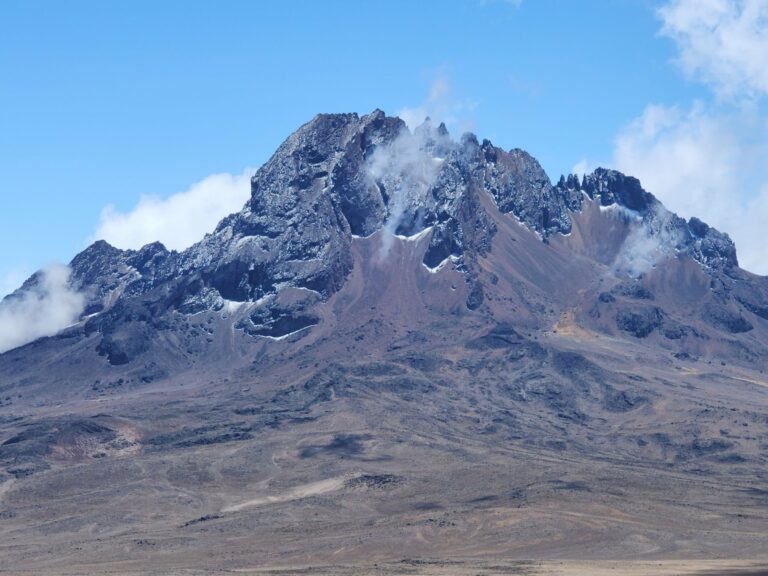
Rongai is the only approach from the north. It climbs through forest to Second Cave and the moorland of Kikelewa, with views over the Kenyan plains, passes beneath the jagged peak of Mawenzi, then crosses the lunar desert of the Saddle to Kibo. Our pages say it is quieter than the southern routes and usually drier. The two Rongai climbs spend five or six nights on the mountain.
The Rongai climbs (quieter, drier, still very high)
Eight days on Rongai
Kilimanjaro Climb: Rongai Route – 8 Days
- 8 days
- From £3,119 per person
- Max 16 people
- Starts and ends in Marangu, Tanzania
- Physical rating: high
- Flights not included
- Departures in January, February, July, August, September, December
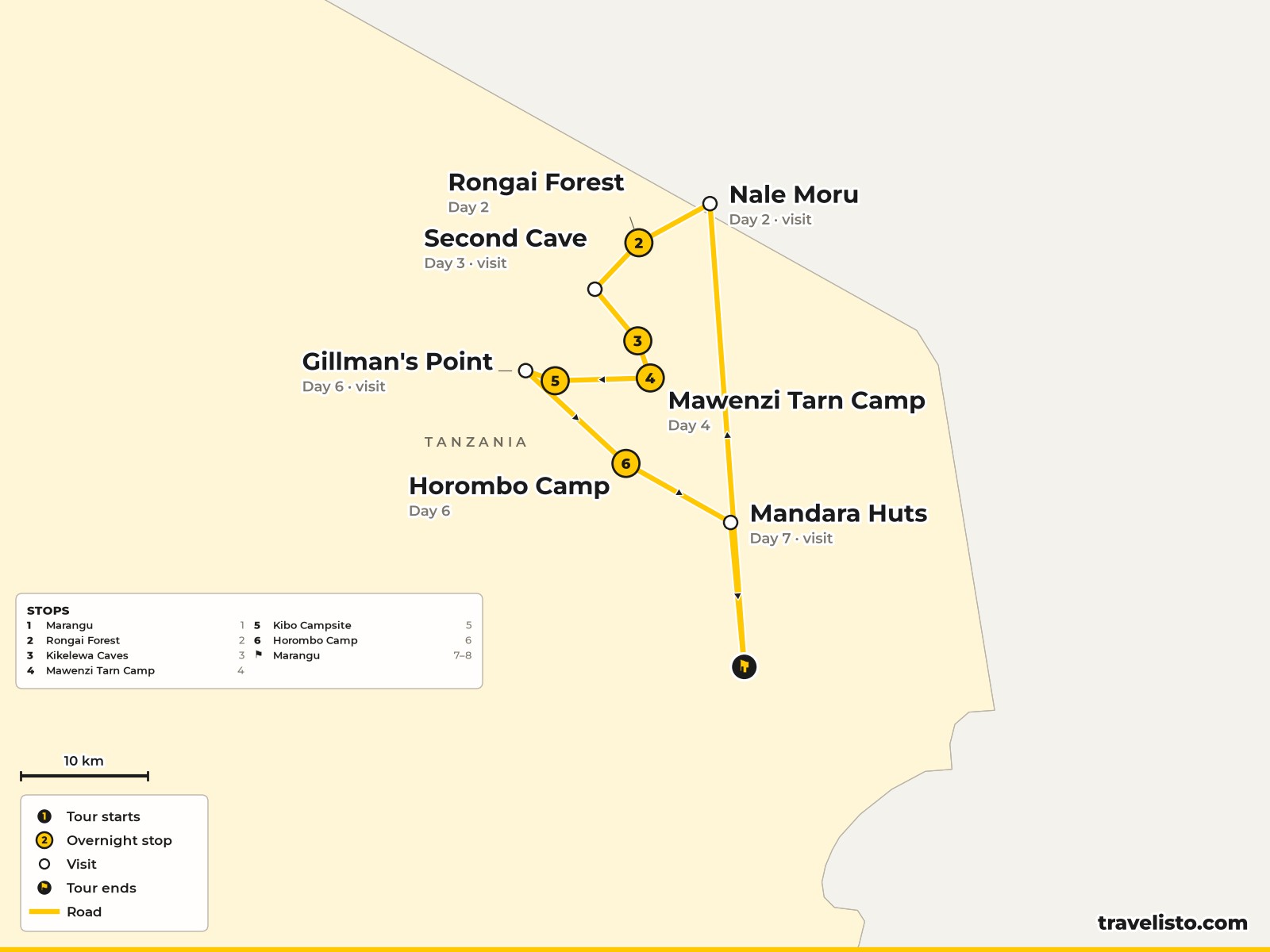
A licensed chief guide leads a group of four to 16, with one guide for every two climbers. You stay two nights at a resort in Marangu and five in full-service mountain camps, with an afternoon acclimatisation walk beneath Mawenzi, then set off by torchlight for Gillman’s Point at sunrise and Uhuru Peak.
Suits: fit walkers who prefer a quieter route. The honest drawback: the page says it is not for you if you want extra acclimatisation days.
Nine days, with an extra night high
Kilimanjaro Rongai Trek from Moshi – 9 Days
- 9 days
- From £2,885 per person
- Max 16 people
- Starts and ends in Moshi, Tanzania
- Physical rating: high
- Flights not included
- Departures in April, May, July, August, September, October
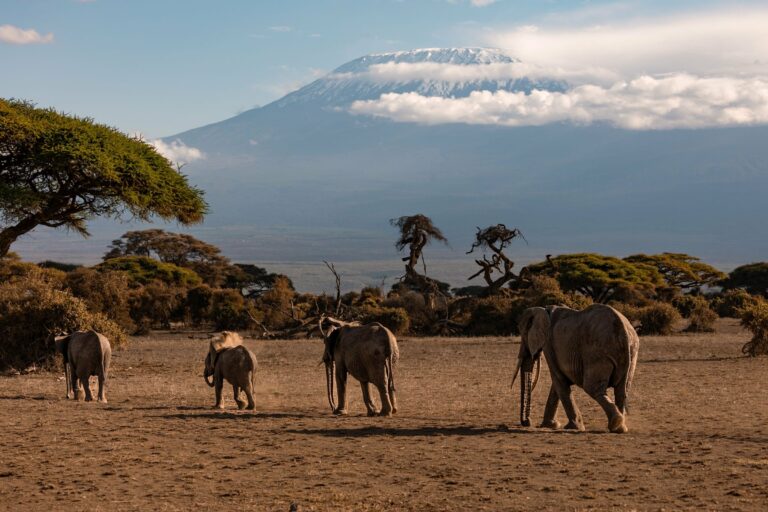
The same route with an extra night high on the mountain to help you acclimatise, including a night at Mawenzi Tarn, a tiny lake beneath the peak. A tour leader, local guides, porters and a cook look after a group of ten to 16, and oxygen and a portable altitude chamber are carried on the trek.
Suits: first-time high-altitude trekkers who want a steady ascent. The honest drawback: groups start at ten, so it is not for anyone who wants a small group.
The Lemosho climbs (the scenic route)
Ten days with an extra day on the Shira Plateau
Kilimanjaro Climb: Lemosho Route – 10 Days
- 10 days
- From £3,812 per person
- Max 16 people
- Starts and ends in Arusha, Tanzania
- Physical rating: high
- Flights not included
- Departures in January, February, July, August, September, October, December
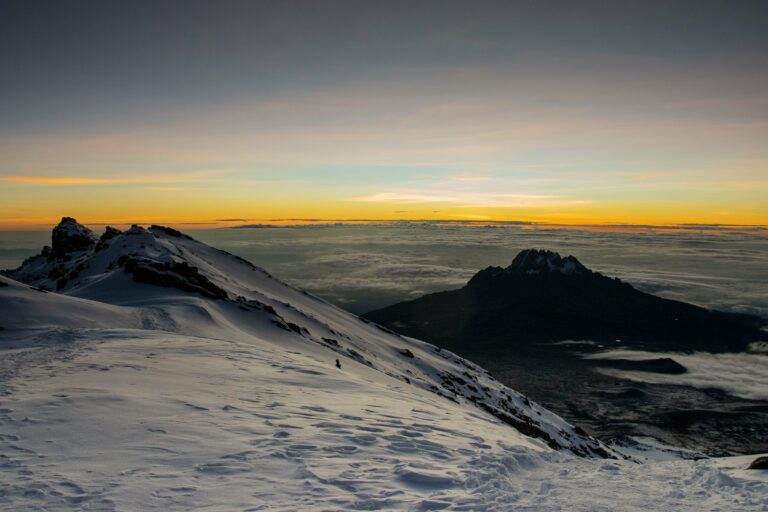
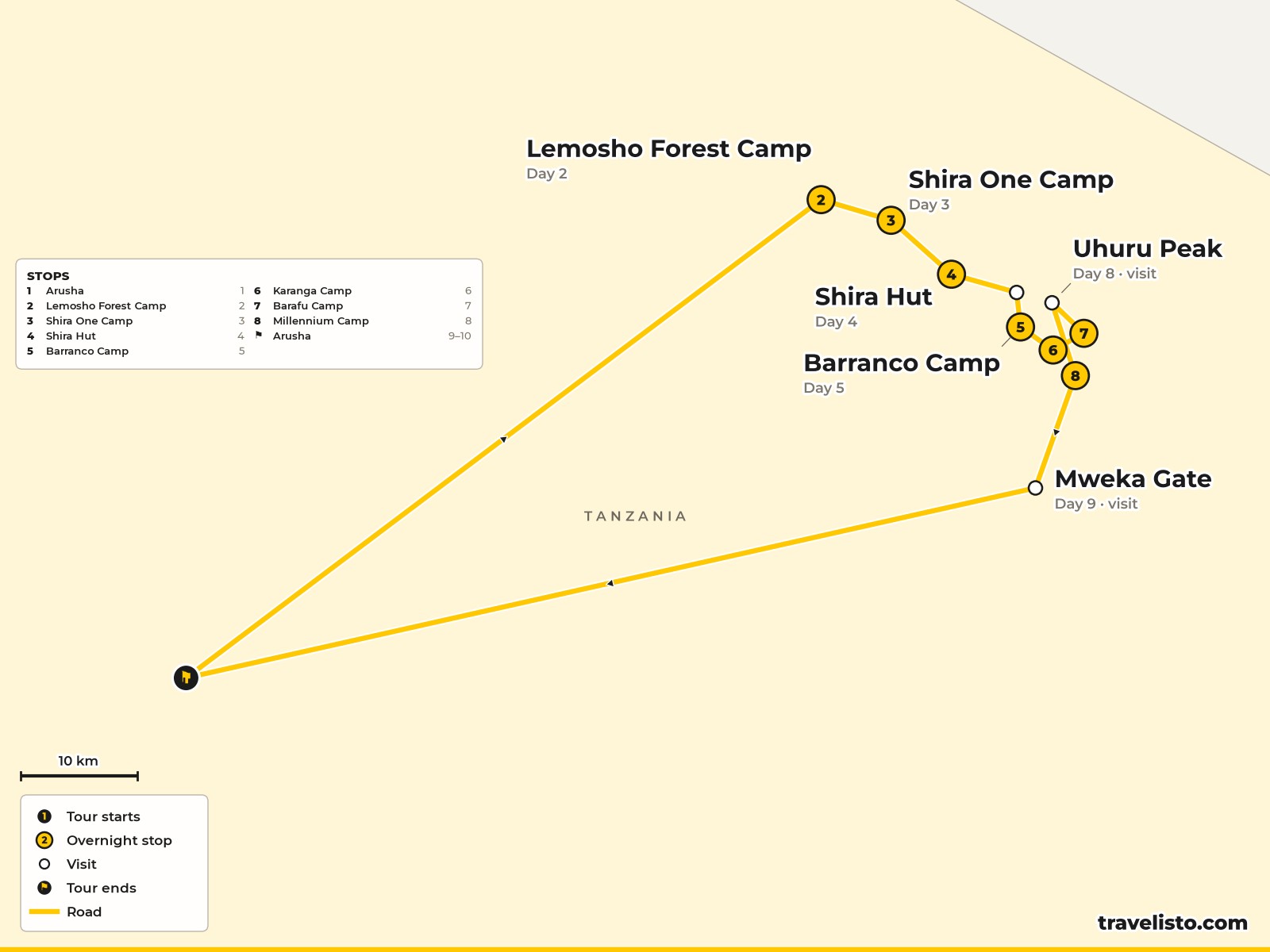
A tour leader and a licensed chief guide lead four to 16 climbers, with one guide for every two climbers on summit day. You stay two nights at a lodge near Arusha and seven in full-service mountain camps, with an extra day on the Shira Plateau to acclimatise. Summit day reaches Stella Point on the crater rim for sunrise, then Uhuru Peak.
Suits: fit, determined walkers who want the best chance of reaching the summit. The honest drawback: it is the most expensive of the climbs, and not for anyone with heart or breathing problems at altitude.
Ten days from Moshi
Kilimanjaro: Lemosho Route Trek – 10 Days
- 10 days
- From £2,340 per person
- Max 16 people
- Starts and ends in Moshi, Tanzania
- Physical rating: high
- Flights not included
- Departures in January, February, June, July, August, September, October, December
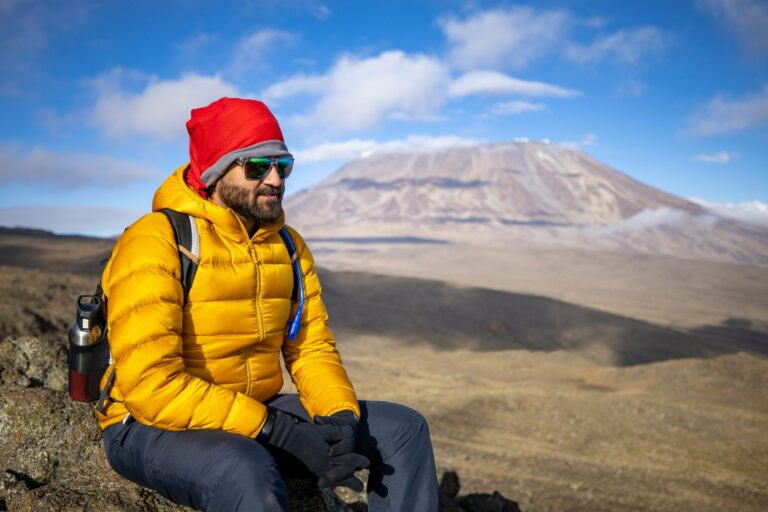
The Lemosho route with a trek leader and mountain crew, two nights at the Weru Weru River Lodge in Moshi or similar and seven nights in two-person tents, all meals on the trek. A longer day via the Lava Tower at 4,640 metres helps you acclimatise, and there is an optional game drive in Arusha National Park at the end.
Suits: fit walkers with a sense of adventure. The honest drawback: a sleeping bag is not included, and the page notes that altitude is the main challenge.
Climb, then safari
Kilimanjaro Lemosho Trek & Safari – 13 Days
- 13 days
- From £3,400 per person
- Max 16 people
- Starts and ends in Moshi, Tanzania
- Physical rating: high
- Flights not included
- Departures in January, February, June, July, August, September, October, December
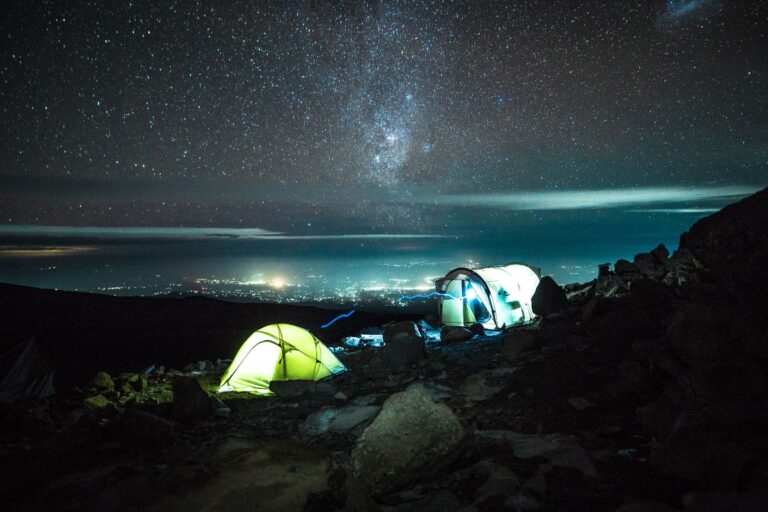
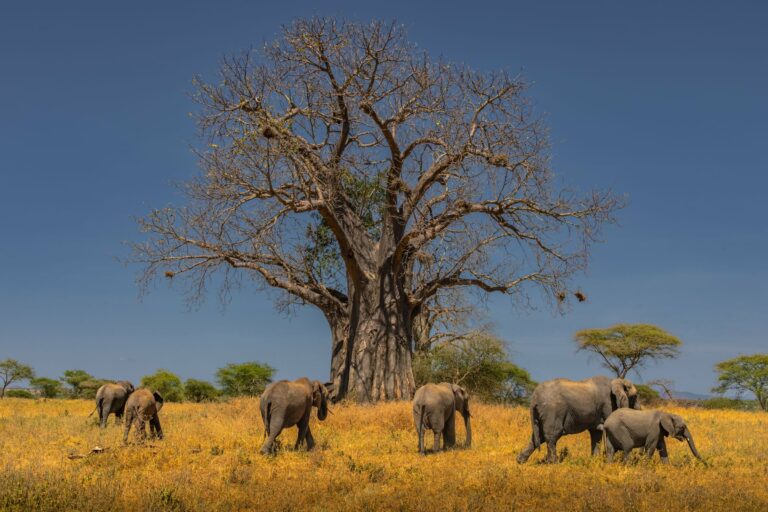
Thirteen days with the Lemosho climb first, seven nights camping, then a safari driver-guide takes over for a first game drive at Lake Manyara, a full day in the Ngorongoro Crater looking for lions, elephants and rhino, and Tarangire, known for its elephants and baobab trees. Almost every meal is included.
Suits: fit walkers who want to see the wildlife afterwards. The honest drawback: the safari is short, at three days of game drives.
How to choose
By time available. Eight or nine days: the Rongai climbs. Ten days: the Lemosho climbs. Thirteen days: Lemosho plus a safari.
By acclimatisation. The Lemosho climbs spend seven nights on the mountain, and the Arusha version adds an extra day on the Shira Plateau. The nine-day Rongai trek adds a night high on the mountain compared with the eight-day climb.
By budget. The Lemosho Route Trek from Moshi is the least expensive and the Arusha-based Lemosho climb the most expensive. Live prices are in the table above.
By fitness. Every climb is rated high. The pages describe long days at high altitude and a night-time summit push, and say good fitness and training are essential. None is for anyone who has never trekked before.
When to go
Most climbs depart from about June or July to October and from December to February; the nine-day Rongai trek also runs in April and May. The months for each tour are in its fact panel above.
Before you travel, check the FCDO travel advice for Tanzania, including entry requirements, and make sure your travel insurance covers trekking to 6,000 metres, as the tour pages advise.
Frequently asked questions
Which is better, Lemosho or Rongai?
Lemosho is the more scenic route, with a good acclimatisation profile and seven nights on the mountain. Rongai is quieter and usually drier, approaching from the north, with five or six nights on the mountain.
How hard is it to climb Kilimanjaro?
Very demanding, according to our tour pages: long days at high altitude and a night-time summit push. Good fitness and training beforehand are essential.
How high is Kilimanjaro?
Uhuru Peak, the summit, is 5,895 metres.
Where do you sleep on the climb?
In tents at the mountain campsites, with a mess tent for meals and a toilet tent. Porters carry the camping kit.
Can I combine Kilimanjaro with a safari?
Yes, the Lemosho Trek & Safari adds Lake Manyara, the Ngorongoro Crater and Tarangire after the climb.
Are flights included?
No, all five climbs are land-only, and we can arrange flights for you.
Ready for the roof of Africa?
Tell us which route appeals and when you would like to climb, and a Travelisto specialist will check dates and prices with you.
Keep planning
- All escorted tours in Tanzania
- Escorted tours in Kenya
- South Africa tours compared
- Costa Rica tours compared
- Tanzania holidays
Prices are live from our tour pages (updated October 2026). Tour details and dates can change; your specialist will confirm everything before you book.